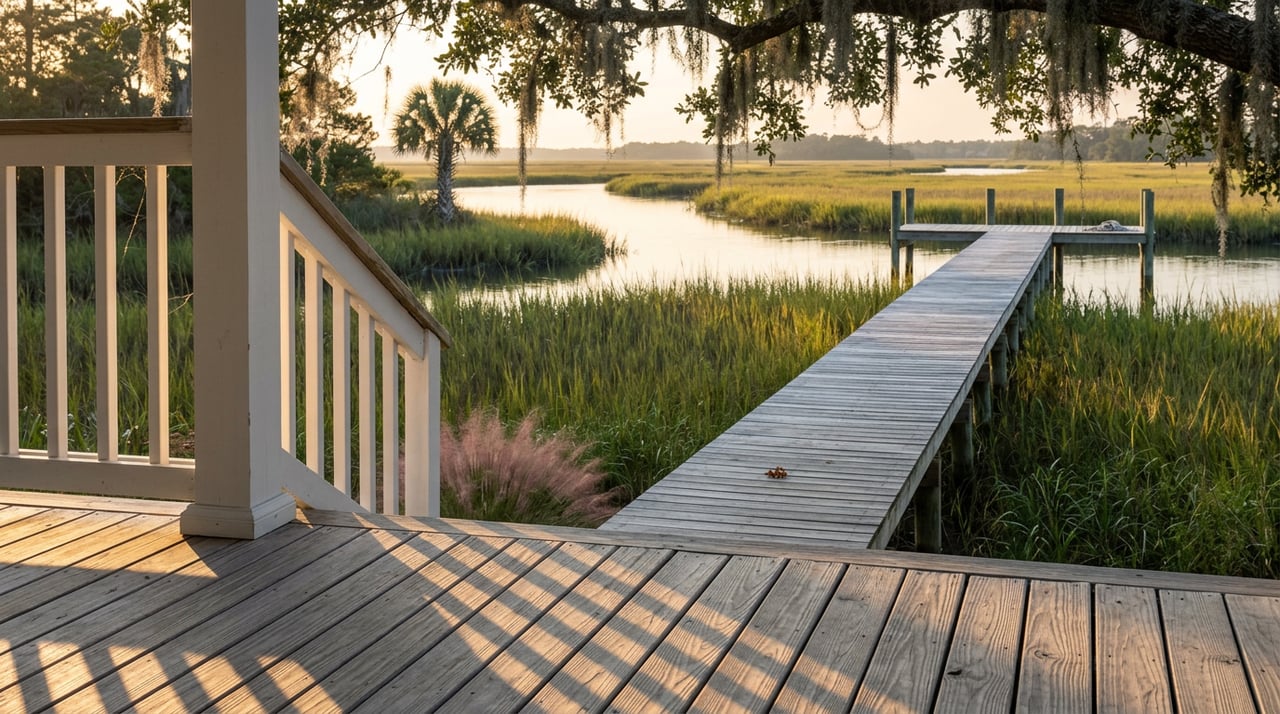
Two listings land in your inbox on the same afternoon. Both say "waterfront." Both show a marsh view at golden hour. Both sit within a few thousand dollars of each other. One will let you tie up a boat behind the house next spring. The other may never let you build a dock at all, no matter what you offer.
Nothing in the listing photos tells you which is which. The word doing the most work in Beaufort real estate right now isn't "waterfront." It's "dock eligible," and almost nobody asks about it before they fall in love with a view.
"Waterfront" Is Three Different Products Wearing One Label
Ask a handful of local brokerages what waterfront costs in Beaufort and you'll get three different answers, because you're really asking about three different kinds of property. Tidal creek homes, the ones tucked along the narrower waterways that flood and drain with the tide, tend to start near $400,000. Deepwater properties, the ones with year-round navigable access to the Intracoastal Waterway or a sound, start closer to $600,000. Premium estates with private deeded slips push past $2 million and, on the high end, past $3 million.
That range isn't really about square footage or finishes. It's about what kind of relationship the property has with the water itself. A home on Distant Island, long regarded as the area's premier waterfront address, comes with private boat slip access to deep water. A home in Habersham, one of the region's best-known planned communities, gives you a shared community dock, tennis and pickleball courts, and a marketplace, but not necessarily a dock behind your own house. Neither is a lesser product. They're different products, and the listing price tells you almost nothing about which one you're getting until you ask the follow-up question.
Why Some Waterfront Lots Never Get a Dock
Here's the part that surprises people who've bought waterfront elsewhere: in South Carolina, owning water frontage does not automatically entitle you to build a private dock. The South Carolina Department of Environmental Services, which permits every dock, bulkhead, and pier in the state's coastal counties including Beaufort, evaluates each request against a Dock Master Plan when the property sits in a platted subdivision. Those plans exist specifically to limit how many private docks get built along a single creek, and the agency's own guidance favors shared or joint-use docks over one dock per lot whenever a community dock is a workable alternative.
The rule gets sharper on narrow water. On any creek under 20 feet wide, a private dock can only be permitted if the lot carries at least 500 feet of water frontage, or if there's no possible dock access from the opposite bank. Even then, boatlifts and davits aren't allowed on those narrow-creek docks, and the structure itself is capped at 50 square feet unless the site qualifies for an exception. That's not a footnote buried in an HOA document. That's a state regulation that can decide, before you ever make an offer, whether the "waterfront" lot you're touring will ever have a boat behind it.
This is why some of Beaufort's most established waterfront neighborhoods lean hard into community docks instead of promising one to every lot. Willow Point and Newpoint market themselves around marsh views and shared dock facilities rather than private ones. Bermuda Bluff and Wrights Point, by contrast, are known specifically for the kind of deep water that supports larger private docks and bigger boats. Battery Shores recently listed a homesite that already comes with a permitted 250-foot private dock in place, which is precisely why that lot commands a premium over a similarly sized parcel a few streets over without one. The dock isn't an amenity added after purchase. In many cases, it's the single most expensive line item baked silently into the asking price.
What the Market Is Actually Rewarding Right Now
This distinction matters more than usual heading into fall 2026, because the broader Beaufort market has cooled just enough to reward precision over price chasing. Local market data through July 2026 showed the median sale price across the Beaufort area at $515,000, down 7.2 percent from a year earlier, with homes taking a median of 51 days to sell, up more than 21 percent year over year. Total inventory fell to 1,971 homes and months of supply dropped to 4.3, even as closed sales slid nearly 20 percent. Buyers are still active. They're simply not overlooking things they used to shrug off, and dock eligibility is exactly the kind of detail a more disciplined buyer now has time to check before writing an offer.
It also explains a puzzle you'll hit if you compare sources. Public listing data for the city of Beaufort alone put the three-month median sale price, through May 2026, at $489,000, while the same window for all of Beaufort County came in at $608,000. Waterfront-specific listings within the city carried a median asking price around $609,000 and averaged 97 days on market, noticeably longer than the roughly 78-day average across all Beaufort home sales. None of those numbers are wrong. They're measuring different products. A citywide median blends starter homes with deepwater estates. A waterfront-only median blends dock-ready properties with lots that will spend the next decade waiting on a shared dock slot. The gap between those figures is the same gap this whole piece is about: price alone can't tell you what kind of water access you're buying.
For buyers stretching into the deepwater and estate tier, financing has also shifted slightly in their favor this year. The 2026 baseline conforming loan limit rose past $806,000, which has made it somewhat easier to finance the upper end of Beaufort's private-dock inventory without automatically stepping into jumbo underwriting.
How to Find Out Before You Fall in Love With the View
None of this shows up in a virtual tour, so the burden falls on asking direct questions early.
- Ask whether the property has an approved Dock Master Plan on file, and whether your specific lot is listed as dock eligible within it.
- Ask if any existing dock is permitted and transferable, or if it was built without the proper critical area permit, which happens more often than buyers expect in older waterfront communities.
- Measure or ask for the creek width at the property line. Anything under 20 feet triggers the frontage and structure restrictions described above.
- If the community relies on a shared dock, ask how slips are assigned and whether there's a waiting list, since that affects your actual timeline to get a boat in the water, not just your deed.
- Budget the $250 minor permit application fee (or $150 for shorter walkways) if you're planning new construction, and expect a longer runway if your project needs sign-off as a major activity rather than a minor one.
These are the kinds of questions that separate a waterfront purchase you'll be happy with in three years from one that quietly disappoints you the first time you try to launch a boat.
A Few Questions Worth Asking Early
Does every home listed as "waterfront" in Beaufort come with water access for a boat? No. Waterfront in South Carolina real estate typically refers to a property's proximity to navigable water, not a guarantee of private dock rights. Marsh-front and narrow-creek lots can be legally waterfront without ever qualifying for a private dock under state permitting rules.
Is a community dock a downgrade from a private one? Not necessarily. Communities like Habersham and Newpoint built their waterfront identity around shared docks precisely because they reduce the number of individual structures crowding a creek, which state regulators also prefer. For many buyers, a well-managed community dock delivers the boating lifestyle at a lower price than a private-dock estate.
How do I confirm dock status before making an offer? Request the property's Dock Master Plan status and any existing permit documentation through the listing agent, and independently confirm creek width and frontage against South Carolina's current critical area permitting standards before treating a private dock as a given.
If you're weighing a waterfront purchase in Beaufort, Lady's Island, Port Royal, or the surrounding Sea Islands and want a straight answer on what a specific property's water access actually includes, Chambers Helms Group can walk the dock question with you before you write an offer, not after you've already fallen for the view. Reach out for your free home valuation and a clear-eyed look at what your budget buys on the water.