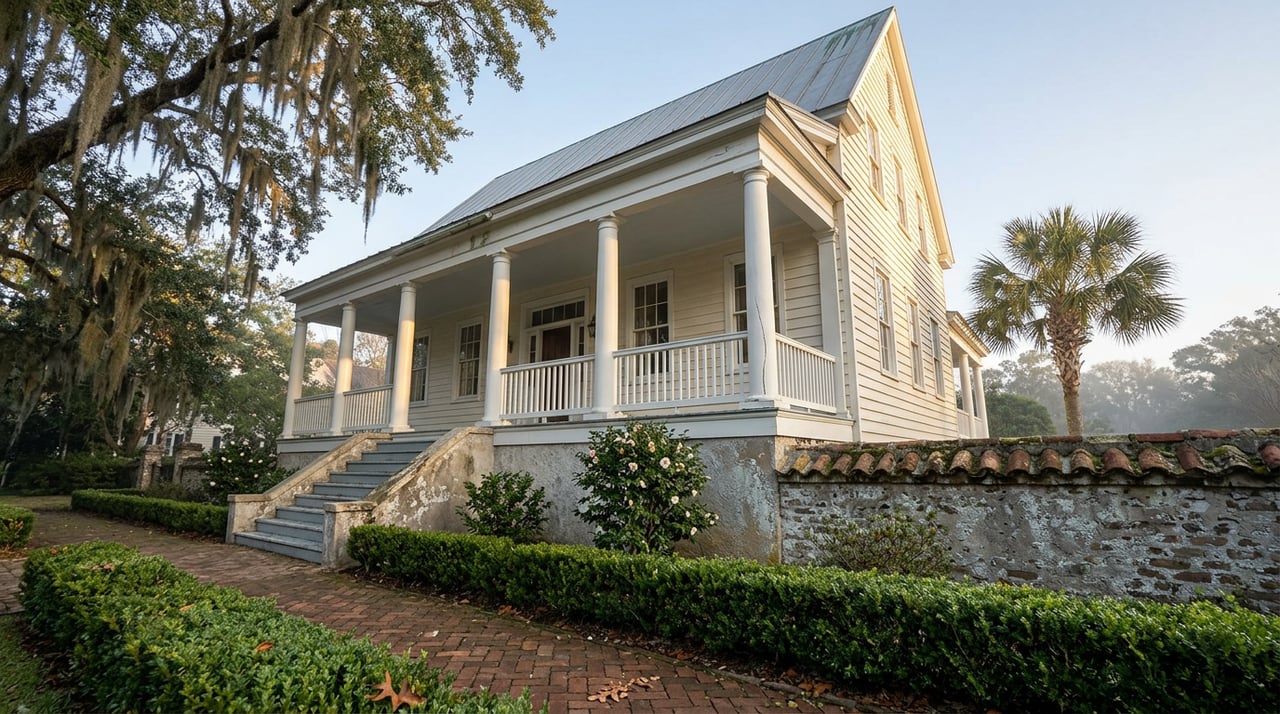
Two cottages, both built before 1900, both a short walk from Bay Street. One sits on Hamar Street. The other sits three blocks north on Duke Street. A buyer touring both in the same afternoon might assume the price difference comes down to condition, or maybe square footage. It doesn't. It comes down to which side of an invisible line drawn in 1969 each house happens to sit on.
That line is the boundary of Beaufort's National Historic Landmark District, and it does more to set price than age, style, or even proximity to the water. Buyers shopping for "historic" character in Beaufort are usually pricing the wrong variable. The house's birth year matters less than whether the Historic District Review Board has jurisdiction over what you're allowed to do to it.
The Line Nobody Points Out on a Listing Sheet
The district covers 304 acres of the original 1711 town plan, bounded by the Beaufort River, Bladen Street, Hamar Street, and Boundary Street. It earned National Register listing in 1969 and National Historic Landmark status in 1973, and in 2001 the city extended the period of architecturally "contributing" construction all the way to 1950, which is why you'll find mid-century bungalows treated with the same seriousness as antebellum mansions inside the line.
Nothing about that boundary shows up in a typical listing description. A home a block outside it can be just as old, just as charming, and framed by the same live oaks. What it won't have is a second layer of local government sitting between the owner and a paint color, a window replacement, or an addition.
What Crossing That Line Actually Costs You
Inside the boundary, the Historic District Review Board has jurisdiction over exterior changes under Section 9.10 of the Beaufort Code. That means a Certificate of Appropriateness before you touch shutters, roofing material, fencing, or an addition. The city's own fee schedule puts a number on this: a base review fee of $500 plus five cents per square foot for most additions. Skip the process and build first, and the fee for that after-the-fact application triples, on top of the risk that the board asks you to undo the work.
A straightforward exterior repaint or a new front door moves through a lighter review. A second-story addition, or any renovation running past half the home's value, triggers a pre-application conference and formatted elevation drawings comparing what exists today to what you're proposing. None of this is unusual for a landmark district. What surprises buyers is how routine it is: the board reviews cases like new gutters and shutter color changes at the same meetings where it weighs additions and new construction.
Cross Bladen, Hamar, or Boundary Street heading out of downtown, and a single-family or small two- to three-unit property is exempt from this review entirely. Same era of house, same Lowcountry porch, zero Certificate of Appropriateness required for the next owner's renovation plans.
Five Neighborhoods Inside One Jurisdiction
The district isn't a single uniform market. It's five recognized sections, and each carries a different price texture even though all five answer to the same review board.
Downtown, centered on Bay Street, is Beaufort's commercial spine, mostly shops and restaurants with residential density around the edges. The Point, sometimes called Old Point, holds the district's largest and most expensive homes, the mansions overlooking the Beaufort River along Craven Street. The Bluff runs along Bay and North Streets just west of downtown, home to some of the city's most photographed facades and the art deco federal courthouse. Old Commons, in the northeast corner, is seeing steady reinvestment in a mix of smaller historic homes. The Northwest Quadrant, Beaufort's historically Black neighborhood along Bladen Street, holds a distinct stock of late 19th and early 20th century shotgun-style homes and has drawn recent rehabilitation attention, though the financial lift on some of that work remains real.
Buying "in the Historic District" can mean a multimillion-dollar riverfront estate on The Point or a modest cottage in Old Commons still working through the same Certificate of Appropriateness process as its wealthier neighbors three blocks away.
The Number That Proves the Line Is the Mechanism
Here's the comparison that isolates the effect. In a March 2026 snapshot, vintage homes listed across all of Beaufort carried a median asking price of $529,000. Vintage homes listed specifically inside the Historic District, same "vintage" label, same general era, carried a median asking price of $1.05 million. That's not a citywide age premium. It's a boundary premium, nearly double for homes that would otherwise sort into the same category on a listing site.
Zoom out to the broader market for context: the median sale price across the Beaufort-Jasper MLS area was $469,670 in May 2026 (Beaufort-Jasper County REALTORS®, Monthly Indicators, May 2026). The Historic District's vintage inventory isn't just outperforming older homes elsewhere in town. It's operating in a different price tier than Beaufort as a whole.
The mechanism behind that gap isn't mysterious once you've seen the review process up close. Buyers are paying for a guarantee: whatever a neighbor does to their exterior next year, it has to clear the same board, follow the same preservation manual, and preserve the same streetscape. That guarantee has a price, and it's a price that architecture alone doesn't explain.
What the Boundary Actually Buys You
None of this is a case against buying inside the line. The review process protects the thing buyers are paying for in the first place. A Bay Street corridor of mismatched vinyl additions would erode the value of every home around it. The board's job is to prevent that, and the market rewards the certainty it provides.
The tradeoff is timeline and flexibility. If your plans include a major addition, a garage conversion, or anything beyond routine maintenance, budget real time for the Certificate of Appropriateness process before you budget for the contractor. If your priority is buying a fixer-upper and moving fast on renovations without a design review step, a comparable home just outside the boundary gets you there faster, even if it never carries quite the same resale story.
How to Find Out Before You Fall for a Listing
The boundary is a matter of public record, but it rarely appears on the listing itself. Before you get attached to a specific address, ask your agent to confirm whether the Historic District Review Board has jurisdiction over it, or check the property's tax map and plat directly. The city's Community and Economic Development Department maintains the official boundary and can confirm a specific parcel's status. The nonprofit Historic Beaufort Foundation is also a useful resource for verifying a structure's actual construction date, which matters if you're weighing whether a home even qualifies as a contributing structure inside the district.
The board's decisions carry real weight. In 2021, the foundation went to court over a board-approved hotel and parking garage downtown, a reminder that these reviews aren't a formality that rubber-stamps whatever an owner proposes. If you're buying with renovation plans already in mind, that history is worth knowing before you write an offer, not after.
We've written before about how Beaufort's luxury tiers break down by neighborhood, and the Historic District boundary is one of the clearest examples of why two homes with similar price tags can come with very different ownership experiences.
A Few Questions Worth Asking Early
Has the boundary itself ever changed? Not since 1969. What changed in 2001 was which construction years count as "contributing" inside that boundary, extended from the original 19th-century cutoff up to 1950. The line on the map has stayed put.
Can a home just outside the line look identical to one inside it? Often, yes. The boundary runs along specific streets, not architectural style, so a home across Boundary Street can share the same porch, roofline, and build year as one inside the district while facing no design review at all.
Does the Certificate of Appropriateness process affect closing timelines? Not directly. The review applies to renovation and construction work, not the sale itself. But if a seller has pending exterior work or an unresolved violation, that can surface during due diligence and is worth asking about before you're under contract.
If you're weighing a historic cottage against a similar home just outside the line, or trying to figure out which side of Boundary Street actually makes sense for your plans, Shae Helms can walk you through what a specific address means for your renovation timeline, your resale position, and your budget. Get Your Free Home Valuation to see where your Beaufort property stands today.